
Estate Cleanout Checklist: Room-by-Room Guide
Handling an Estate Cleanout Room by Room
Clearing out a family member’s home after a death or major life transition is one of the more emotionally difficult projects a family can face, and the practical side of it deciding what to keep, what to donate, and what needs to be hauled away often gets tangled up with grief, nostalgia, and simple decision fatigue. Having a clear, room-by-room approach can make the physical work more manageable, even when the emotional part isn’t something an Estate Cleanout Checklist can solve.
Starting With a Realistic Plan
An Estate Cleanout Checklist can help you get a clear picture of the work before sorting begins, especially when the property includes several rooms, a garage, attic, or basement. Before any sorting begins, it helps to walk through the property and get a general sense of scale — how many rooms, how full each one is, whether there’s a garage, attic, or basement involved — since this shapes both the timeline and the disposal approach more than any single decision made along the way.
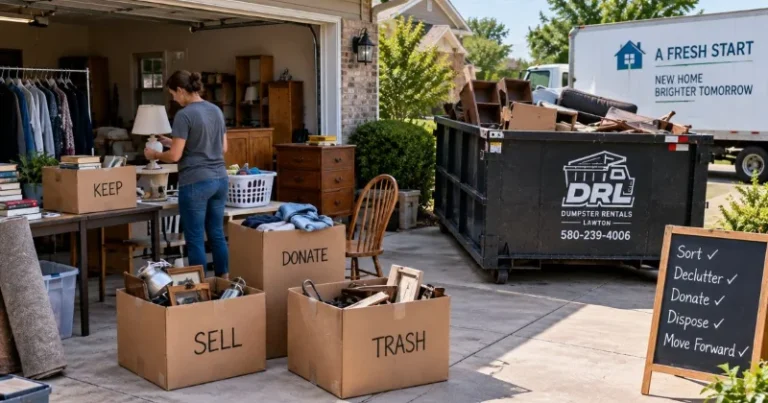
It’s worth setting expectations early that an estate cleanout rarely finishes in a single day, even for a modest home. Splitting the work across several sessions, with clear categories for keep, donate, sell, and dispose, tends to produce better outcomes than trying to make every decision in one exhausting push.
Living Areas and Bedrooms
Living rooms and bedrooms usually contain the mix of items with the most sentimental weight — photographs, personal keepsakes, furniture with family history — alongside genuinely disposable items like worn-out furniture, outdated electronics, and general clutter. Separating sentimental items into their own designated space early, even before deciding exactly what to do with them, prevents them from getting mixed in with debris headed for disposal.

Furniture is often the largest volume contributor from these rooms. Pieces in good condition may have donation or resale value, while damaged or outdated furniture typically needs to go straight to disposal. Mattresses in particular often require separate handling — many providers accept them but may apply a specific handling fee, so it’s worth asking about this directly when planning for larger furniture removal.
Kitchen Estate Cleanout and Sorting
Kitchens tend to move faster than other rooms since much of the contents — dishware, small appliances, pantry items — are lower in sentimental value and easier to sort quickly. Working appliances often have donation value, while expired food, broken equipment, and single-use plastics typically go straight to disposal.

Large appliances like refrigerators and freezers require some extra planning, since many disposal facilities and dumpster rental providers require refrigerant to be professionally removed before the appliance can go into a container. This is worth confirming ahead of time so it doesn’t become a delay once the cleanout is already underway.
Garages, Basements, and Attics
These spaces are frequently where the largest volume of accumulated items ends up, often because they’ve served as long-term storage for things that were never sorted through in the years before a death or move. Tools, old paint cans, holiday decorations, and general storage overflow are common finds, and the sheer quantity can be surprising even in a home that looked tidy from the main living areas.
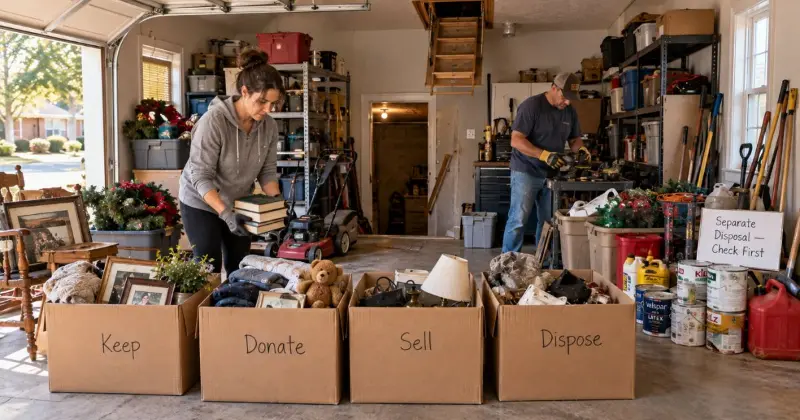
Paint cans deserve particular attention, since fully dried, empty cans are generally fine for standard disposal, but cans with liquid paint still inside are typically treated as hazardous material and require separate handling rather than going into a dumpster. Checking cans before loading them saves a headache later in the process. For general guidance on handling household hazardous materials, see the EPA Household Hazardous Waste Guide.
Sorting Categories That Actually Work
A simple four-category Estate Cleanout Checklist tends to work well across an entire property: keep, donate, sell, and dispose. Keep items go into a clearly marked area untouched by the rest of the process. Donate items such as clothing, working furniture, books, and usable household goods to local charitable organizations, which reduces both landfill volume and disposal costs. Sell items, particularly higher-value furniture, collectibles, or electronics, may be worth listing separately rather than lumping in with a general donation run. Everything else goes to dispose, which is where an estate cleanout dumpster rental becomes the practical tool for handling volume efficiently.
Sizing a Dumpster for Your Estate Cleanout Checklist
An Estate Cleanout Checklist can help you estimate how much disposal volume the property may generate before choosing a dumpster size. For a single room or a modest apartment, a 10 or 15-yard container is often sufficient. For a full house cleanout involving multiple bedrooms, a garage, and general household accumulation, a 20-yard container tends to be the more realistic starting point, with larger 30-yard containers coming into play for homes with extensive garage, attic, or basement contents on top of the main living spaces.
Because estate cleanouts frequently unfold over several sessions rather than a single continuous day, a standard rental period of a week to ten days tends to fit the pace better than assuming everything will be sorted and hauled in one visit. Keeping the container on-site for the full sorting process means debris can be loaded gradually as decisions get made, rather than needing everything finalized before disposal even begins.
Working With Estate Sale or Auction Companies
Some families choose to bring in an estate sale or auction company before the final cleanout begins, which can meaningfully reduce the volume that ultimately needs disposal, since items with resale value get separated out professionally rather than potentially ending up in a dumpster by default. If an estate sale is part of the plan, it generally makes sense to schedule the dumpster rental for after the sale concludes, once it’s clear what’s left over and genuinely needs to be hauled away.
For families handling the cleanout entirely on their own without a sale, the same sorting principle still applies — separating anything with potential value before loading the dumpster tends to reduce both disposal volume and any sense of loss that comes with realizing later that something worth keeping or selling went out with the rest of the debris.
Placement and Practical Logistics
For most Lawton properties, a driveway placement is the simplest option and typically doesn’t require any special permit since it sits on private property. For homes without driveway access, or in situations where the dumpster needs to be placed on a street, checking whether a dumpster rental permit is needed ahead of time avoids any last-minute complications during an already emotionally taxing process.
Handling Disagreements Among Family Members
It’s common for family members to disagree about what should be kept versus disposed of during an estate cleanout, particularly with items that carry different meaning for different people. Setting aside a neutral holding area for anything genuinely contested — rather than making an immediate keep-or-dispose call under time pressure — gives everyone room to revisit the decision later without it becoming a rushed, emotionally charged moment in front of a half-loaded dumpster.
Having a full rental period of a week to ten days, rather than trying to compress everything into a single day, generally makes room for these conversations to happen naturally rather than forcing quick decisions that family members might regret later. For a smaller portion of the estate, it may be worth comparing costs against DIY junk removal — though full estate cleanouts almost always favor a dumpster. Other life-transition cleanouts, like a Fort Sill PCS move, follow a similar planning approach.
Frequently Asked Questions
What items commonly get overlooked during an estate cleanout?
Items stored in less obvious places — under-bed storage, the backs of closets, garage rafters — are often missed during an initial walkthrough. A second pass through each room after the main sorting is done tends to catch these before the dumpster gets picked up.
Can documents and paperwork go directly into the dumpster?
General paperwork is generally fine for standard disposal, but documents containing sensitive personal information are usually worth shredding first rather than placing directly into a dumpster, since the container sits accessible on the property until pickup.
How Does an Estate Cleanout Checklist Help With Dumpster Planning?
An Estate Cleanout Checklist helps you track each room and identify how much needs to be kept, donated, sold, or disposed of. Once you have a clearer idea of the disposal volume, choosing between one dumpster or multiple pickups becomes easier.
Giving Yourself Room to Go at Your Own Pace
An estate cleanout is rarely just a logistics project — it’s also a process of saying goodbye to a space that held meaning for someone. Having the practical side handled clearly, with a dumpster sized appropriately and a rental period that matches a realistic pace rather than a rushed one, can take some of the pressure off so that the harder emotional decisions get the attention they deserve.
For families working through this process in Lawton or the surrounding area, the dumpster sizes guide offers a closer look at what each container size realistically holds. This can help you estimate disposal volume before the first sorting session begins.
Need a dumpster for an estate cleanout in Lawton? Choose the size that fits your cleanup and schedule delivery before the sorting begins.